

The Demon
(2127 words)

Braunua Austria 1888
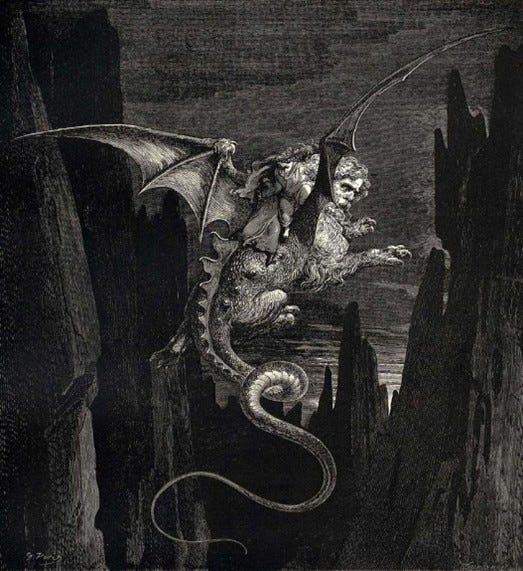
The demon had been confined to the bottom of the deepest and darkest of all sulfurous pits for an uncountable amount of time. Throughout those endless centuries, the hatred it felt towards the pinhole of light miles above it had transformed from a cloud of poisonous gas into a pool of molten rock. This black magic pleased its master so much that he decided to release the creature and allow it to fly up through the fiery canyons of hell and enter the world of men.
The demon’s first host, a struggling artist who had been employed by a wealthy jeweler to teach his children how to paint, had murdered the entire family—in broad daylight— outside their synagogue. At sentencing, the Judge asked the madman why he’d done such a terrible thing to people who had shown him nothing but kindness and mercy. After a moment of quiet reflection, the killer replied, “Modsiw ot syawhtap eurt ylno eht are htaed dna ecneloiv taht em decnivnoc evyeht, gnol os rof senob ym ta yawa dewang evyeht dna, star evil fo lluf os si ytivac tsehc ym.” Sickened by the crime and angered by the gibberish, the Judge committed the lunatic into the care of a local asylum. Later that day, the court recorder—who happened to be an amateur cryptologist—realized the crazed criminal had been speaking backwards and had actually told the judge, “My chest cavity is so full of live rats, and they’ve gnawed away at my bones for so long, they’ve convinced me that violence and death are the only true pathways to wisdom.”
The asylum’s cellar was a series of dark, dead-end passageways that housed the most unpredictable and dangerous of its patients. Above each cell door, hung from hooks in the low soot-stained ceiling, old oil lanterns emitted a dull orange glow that only hinted at what the cold, filth-filled corridors actually looked like.
As the murderer was being escorted down into the dungeon, he broke free from the two huge orderlies who had a hold of him and flew at a nurse handing out sedatives to patients who had begun to bleat like goats, pull out their hair, and urinate on their filthy straw-filled mattresses. As the crazed killer bit and clawed at the nurse’s exposed skin, the spirit-creature entered her body through her open mouth as she screamed for help. Then, in a frightening frenzy of unbridled violence, the two orderlies were consumed by a bout of animal ferocity, as the struggling artist awoke from the most dreadful of all dreams, only to find himself in a subterranean cellblock being beaten to death by muscular thugs in white scrubs.
In the days that followed the savage assault, Nurse Heckmier came close to death on several occasions. Her doctor said it was a miracle she’d survived. The claw and bite marks on her hands, face, and neck were horrific. Weeks later, as the permanent results of the emergency stitching became visible, it was apparent that the nurse’s future was going to be filled with torment and misery. After a partial physical recovery, those who knew her recognized that although her body seemed to be on the mend, something inside her mind had snapped beyond repair. At night, her frightened neighbors could hear her howling like a tortured animal and smashing up the inside of her house—and on the morning of Christmas 1888, she ran naked into the town square, screaming hysterically that she was on fire. Following that, one bitterly cold February morning, dressed in a blood-stained nightgown, she walked barefoot into the police station on Grubber Strassen to inform the Bundespolizei that she had just killed her two Alsatian dogs because they would not stop telling her to do “terrible things”.
It was Father Kurtz who first mentioned the word “Evil”. As the community’s direct conduit to the almighty, all-knowing god, the words he used had great power over his parishioners. Nurse Heckmier’s frightening behavior had set the fears of the faithful on fire. Talk of demonic possession had only fanned those flames until, after a great deal of deliberation and prayer, it was decided that the demon must be drawn out.
The night of the planned exorcism was wet and windy. A spring storm that had golloped and flapped its way up the valley had become trapped by the mountains surrounding the town. Inside the old church at the edge of the market square, dozens of candles set out in the shape of a cross illuminated the sanctuary, the baptism font, and a wooden bucket full of holy water on the floor in front of it. And as Father Kurtz kneeled before the pulpit, with his hands clasped tightly together, and his eyes squeezed shut, he felt the flickering flames of the votive candles defending him from the darkness as he petitioned all three members of the holy trinity for enough strength to perform the task at hand.
Stephan Fritz and Joseph Schafer, the two men tasked by Father Kurtz to bring Nurse Heckmier into town, were in their mid-thirties and were immensely strong, both physically and in their commitment to Christ. When they arrived at the nurse’s house, they found her standing outside the front door in the pouring rain, dressed in a rag of a skirt and a thin, sleeveless blouse. Fritz and Schafer were shocked by her appearance. In the months since the attack, she had become emaciated and gaunt, and the crude stitching had turned her pale, haggard face into a contorted maze of tiny twisted train tracks. As the two men approached—in a soft, almost childlike voice—Nurse Heckmier said, “I’m so glad you’re here. I’ve been waiting for you.” Fritz and Schafer were startled. As far as they knew, only Father Kurtz and a select group of church elders had any knowledge of their assignment.
As high winds and heavy rain hurtled across the rooftops of the old town, Alois paced nonstop across the floor of the bar room in the building where he and his wife rented an apartment. In his right hand, he held a half-full brandy glass, and each time he heard his bride scream in the room above the bar, he took another slug of liquor and winced up at the ceiling. Over the tops of their beer steins and through clouds of pipe smoke, the tavern’s other customers whispered about Alois and his young wife and hoped that this time everything would work out for them.
Alois’s wife, Klara, was more than a dozen hours into the delivery of her fourth child. Her first three children, Gustav, Ida, and Otto, had not survived past the age of three. After the death of little Otto, Klara had turned in on herself and seldom left the apartment. Alois had thrown himself into his job as a customs official. He became addicted to the duty of it. Work as an anesthetic from uncontrolled family failure and the increased resentment he felt towards his wife. In Alois’s proud, officious mind, Klara’s inability to produce strong, resilient children made him look weak and unmanly. But beneath his simmering macho anger and Klara’s profound feelings of maternal failure, a corrupt bond bound the couple together in a way that was never openly talked about. Their union was within the bounds of the legal system, but it was outside the law of nature. Alois was the youngest brother of Klara’s Grandfather. As a child, she had always referred to him as her Great Uncle. But for the last few years, that title had changed to husband.
The midwife hated breech births. So often, the infant or the mother did not make it. And on some heartbreaking occasions, both parent and child failed to survive the countless hours of blood loss and trauma. Klara’s baby had been particularly stubborn. It had refused to rotate. And all the old wives’ tricks of placing clothespins on the mother’s toes, making her drink cold orange juice, and performing ridiculous cat stretches and headstands had all failed.
The midwife walked over to the window and peered out at the large, leafless poplar tree in the center of the town square. The torrential rain and flashing lightning made its wet, naked limbs look like a hideous skeletal hand reaching up out of the earth to claw at the black, sin-soaked sky. On the far side of the square, left and right of the churches’ double-oak doors, two oil lanterns swung around in the wind like executed criminals hanging from the gallows. The midwife narrowed her eyes to make sure she wasn’t seeing things. The flickering flames of the lanterns somehow made the wet cobbles look alive, as if the storm had conjured up a plague of rats and released them into the town.
Moments after the midwife turned away from the window, Father Kurtz appeared in the arched entranceway of the church and peered out into the rain-raked night. In his left hand, he held a rosary; in his right, a silver crucifix. Then, out of the maelstrom they appeared, heads down, shoulders hunched against the torrential rain. Fritz and Shafer held Nurse Heckmier up by her armpits as she staggered forward, with her eyes rolling back in her head, and a thick yellow drool dripping out of the corner of her scab-covered mouth.
In the rented room above the smoky tavern, Klara screamed out in agony, dug her heels into the mattress, and gripped the sheets on either side of her hips. Miraculously, the baby had flipped. The midwife placed her hands between her patient’s knees and yelled, “Push, Klara, push! You’re almost there. I can see the head!” Klara felt as if she were being torn in two. She forced herself—the way only a woman can—to push past the pain and bear down again and again.
Nurse Heckmier howled like a Jackyl caught in a Gin Trap as the two big men carried her up the broad stone steps of the church. In an attempt to stay out of the house of god, her wet fingers grabbed hold of the old oak door frame and sizzled like raw meat on a red-hot grill. Father Kurtz gasped in horror and then sprinted inside the church, grabbed the bucket from the foot of the baptism font by its rope handle, and with holy water sloshing over the hem of his long black robe, he raced back to the front door. What he found there didn’t make any sense. Nurse Heckmier looked ten feet tall. Fritz and Shafer lay lifeless at her feet, the features of their broad, handsome faces locked in pain, their thick, muscular necks horribly twisted and broken.
“I command thee in the name of Jesus Christ to come out of her,” bellowed Father Kurtz as he flung the contents of the bucket through the air. As the holy water hit the nurse’s now unrecognizable face, the full force of the storm crashed into the town, peeled thousands of tiles from rooftops, and scattered them into the night like playing cards tossed from a moving train. Windows left open in unattended rooms ripped off their hinges and then smashed onto the cobbled streets below, while terrified farm animals cowered in the corners of their stables and barns, and every child within a hundred miles of the town woke up screaming for their parents.
Father Kurtz dropped the bucket and pulled the silver crucifix out of the pocket of his robe. He pointed it up at the towering abomination that used to be Nurse Heckmier, and yelled, “In the name of the Father and the Son and the Holy Spirit, I command thee to flee!”. A bizarre blast of hot, hurricane-strength wind roared through the old town. A noise like the rumbling bass notes of a broken pipe organ flew out of the possessed woman’s mouth. Nurse Heckmier fell to the ground, dead. Father Kurtz dropped to his knees, exhausted. The huge poplar tree in the town square ripped out of the ground and crashed into the outside wall of the tavern. In the rented room above the bar, Klara released a high-pitched, blood-curdling scream. Brandy glass in hand, Alois sprinted up the stairs and burst into the apartment. The scene was a nightmare. A wet, naked tree limb had crashed through the window. Shards of broken glass lay scattered across the wet wooden floor. Drenched in sweat, legs akimbo, Klara lay on the blood-soaked bed, gasping for breath. As the empty brandy glass slipped from Alois’s shaking fingers and shattered at his feet, the weary midwife held up a black-haired infant and shouted, “Herr Hitler, it’s a boy.”