

The Funeral Director
The end brings both dread and hope. (1837 words)

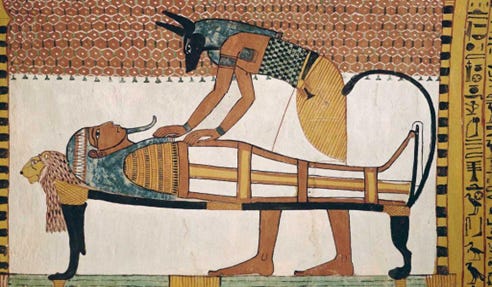
After learning that he only had a few weeks left to live, Mr. Marcus Mullholand—who had made a fortune from importing Egyptian Cotton into the US—was advised to make sure all his affairs were in order. There was surprisingly little to do. The will had already been set in stone. His wife, four daughters, grandchildren, housekeeper, and her gardener-husband would all be well taken care of, in light of their love and loyalty towards a man who had always been a bit of an enigma to them. The only loose end Mr. Mullholand had to tie up was to organize his own funeral.
After decades of working as an undertaker, the tall, bald, stern-looking Mr. Norton Dennison thought he had heard it all. In the past, he had made it possible for countless clients to transition into the afterlife accompanied by a variety of special requests. There had been stuffed pets, golf clubs, unfinished novels, little black books, and on more than one occasion, the ashes of a loved one who had preceded the deceased on the road to glory. But what Mr. Mullholand was about to ask Funeral Director Dennison—and pay him four times his regular rate, if he could arrange it—would be hands-down, the most bizarre request the mortician would ever hear.
In a dimly lit bedroom decorated with ancient Egyptian artifacts, framed hieroglyphs, and a spectacular wall-sized fresco of The Battle of Kadesh, depicting a chariot-driving Ramses II leading thousands of foot-soldiers into battle against the Hittites, Mr. Mullholand sat propped up against a pile of pillows in a gigantic four-poster bed. As Mr. Dennison entered the room, the near skeletal Mr. Mullholand released a chest-rattling cough, spat a blob of blood-flecked phlegm into a white linen handkerchief, and then beckoned the undertaker over to his bedside.
“I hear you have a very good reputation,” wheezed Mr. Mulholland.
Mr. Dennison nodded respectfully and said, “I work very hard to make sure the families I attend to are happy with the service I provide.”
“It’s your reputation for discretion that has prompted me to contact you,” said Mr. Mullholland. Who coughed into his handkerchief again and then continued, “If we can come to an agreement, I need what I’m about to ask you to do to stay between the two of us, and no one else.” Mr. Dennison blinked slowly, pursed his lips, and then replied, “I share every detail of my work with my partner, who happens to be my oldest son, a most honest and reliable young man, whom I trust implicitly. So if this matter is not something I can share with him, I might not be the right person for the job.”
Mr. Mullholand’s weak, watery eyes wandered around the room for a few moments, then refocused on Mr. Dennison’s face.
“I love that your son is your partner,” said Mr. Mullholand. “It speaks volumes about you and your family. So, do I understand that his reputation is in keeping with your own?”
“One hundred percent,” said Mr. Dennison.
Mr. Mullholand nodded thoughtfully, then replied, “That’s good to hear. So, this is what I want. And please excuse the pun,” Mr. Mullholand cracked a wry smile, then said, “both you and your son will have to take it to your graves.”
Mr. Dennison returned a tight professional smile and replied, “I understand. To our graves.”
Mr. Mullholand released several shallow breaths, pushed himself into a more upright sitting position, and said, “I am planning to travel into the afterlife with two twenty-pound gold bars in my coffin. The gold is a gift for the God Osiris, who I believe with all my heart is real, and rules over Aaru and The Field of Reeds.” Mr. Mullholand took another constricted breath, focused on the features of Mr. Dennison’s shrewd, worldly face, and then whispered, “It’s a real place, you know, where the divine one holds open the doors to Paradise for all those who deserve to be let in.”
Without breaking eye contact with his prospective client, Mr. Dennison clasped his hands together in front of his belt buckle, nodded, and replied, “I am here to serve. I’ll take care of everything with the utmost discretion. And it will be my absolute pleasure to do so.”
One week later, Mr. Marcus Mullholand passed away peacefully in his sleep with his family by his bedside. And because he was under the influence of so much morphine, he was blissfully unaware of the transition from present to past tense. After the family's brief and solemn venting of emotion, Funeral Director Dennison was called and arrived twenty minutes later with his oldest son, James, an intelligent, conscientious young man, who—despite the thirty-year age difference—was the spitting image of his tall, bald, handsome father. Out of all seven of Mr. Dennison’s adult children, James was the only one who truly understood the gravity of his father’s work, how well it provided for their large family, and its importance in regard to the service it provided their community.
Back at the funeral home—in the embalming room—the difficult and delicate work of temporarily preserving the corpse started immediately. The removal of Mr. Mulholland’s cream-colored linen pajamas, the washing and disinfecting of the withered body, and the evacuation of its internal fluids. The injection of embalming solutions with the centrifugal pump was performed by Mr. Dennison while James vigorously massaged the clammy, waxy body to break up any circulatory clots, ensuring the correct distribution of chemicals. The younger Dennison then made a small incision just above the navel and pushed the trocar—a sharp, eighteen-inch, hollow stainless steel instrument—up into the stomach and chest cavities to puncture all the hollow organs and drain them of their quickly congealing contents. Next, the vacant cavities were pumped full of formaldehyde before the equipment was removed and the incision neatly sealed with what in the trade is called a trocar button. After that came the sewing shut of the gums. The threading of the large curved needle and wire around the upper and lower jaw, and then through the septum to make sure the mouth stayed closed. And then lastly, a couple of all-important final steps… the packing of the nose and throat with surgical cotton balls to prevent any unexpected leakage, and the insertion of the spiked oval eye-cap-cups between the sunken eye balls and loose eyelids.
“I always hate this part,” said James, as he pressed the spiked eye-cap-cups down onto the boiled-egg-like pupils and stretched the lifeless eyelids into place. “There’s something about the corpse staring at me that gives me the creeps.”
As Mr. Dennison removed Mr. Mulholland’s white, long-sleeved, ankle-length burial dishdasha from the closet, he told his son, “You’ll get used to it. Remember, the customer must always display that just sleeping look. And we must avoid at all costs the ghoulish event of their eyelids popping open during a viewing. Keep in mind, son, all the body has to do is just lie there.”
Once, in the case of a rather gruesome decapitation, Funeral Director Dennison used a wooden dowel to rejoin the head and body and then sutured the neck back together. Then, after adding a little wax, some cosmetics, and a shirt and tie, the body looked perfectly presentable. One of Mr. Dennison's most challenging jobs was a woman who had committed suicide by throwing herself under a speeding train. The mangled corpse, severed below the elbows, ribs, and pelvis, required a technique called sectional injection, which allows the various pieces of the body to sit out overnight until everything is firm and dry. Then, throughout the next day, Mr. Dennison used all his skills to piece the poor woman back together, stitch by stitch, limbs and torso, until her entire body—once fully dressed—looked like it should, and was able to provide the grieving family with an open casket viewing.
“A good mortician,” preached Mr. Dennison, “should always be keenly aware of just how much it matters to people to see their family member, one final time, just as they remembered them. Saying goodbye to a loved one is a basic human need, and something people have been doing since the dawn of time.”
The coffin Mr. Mullholland had commissioned to carry him into eternity was more of a work of art than a thing of function. Crafted from seasoned Ficus Sycamore, it had a simple interior with a burial mat and headrest made from papyrus reeds, both tastefully encased in a Giza linen slip cover and pillowcase. The four sides of the hardwood sarcophagus were covered with hand-carved images of cats, crocodiles, birds, and baboons. And on the lid of the casket was a painting of a rather regal-looking sphinx sitting in front of a pair of shining white pyramids.
“This thing must have cost a fortune,” said the son.
“Money to burn,” replied the father, “money to burn.”
As the Dennisons made their final preparations for the following morning's viewing, James opened the office safe, bent over, grabbed a highly polished ebony box, grunted as he removed the weighty container from the safe, then crossed the room and carefully lowered the box into the coffin. As Mr. Dennison watched his son position the tiny wooden chest between Mr. Mulholland’s sandaled feet, a rush of adrenaline surged through his tall, slim body, like a mild electric shock. Without looking at his assistant son, the father walked over to the casket, opened the black lacquered box, and stared longingly at its contents. A yellow, buttery glow reflected off the undertaker's distinguished face, aquiline nose, and shiny bald forehead. Then, Mr. Dennison reached into the coffin, grabbed hold of both twenty-pound gold bars, and with a gentle heave, picked them up, walked back across the room, and returned them to the safe.
“Dad!” exclaimed the son, “What the hell are you doing?”
Taken aback by the confrontational nature of the question, Mr. Dennison stared at his adult child. But before he could even form a response, the shocked son held out both hands, and for a second time, at volume, demanded to know, “What on earth are you doing? Mr. Mullholand wants to take those gold bars with him into the next life. That’s why he’s paid us four times our regular rate. Not complying with his wishes is completely unethical, unprofessional, and wrong in every single way. In fact, Dad, it’s called stealing!”
Impressed by his son's principled stand and burning desire to do the right thing, which included the current role reversal—the student admonishing the master—Mr. Dennison reached into the inside breast pocket of his black suit jacket, removed a piece of oblong paper, and said, “Look,” the undertaker held the piece of paper up for his assistant to see, “Everything’s going to be fine. I’ve written Mr. Mullholand a check for two million dollars.”
Great read!!
Well that’s interesting and I’d say there would be a bit of Justice in there somewhere lol